| Items |

E11CF6880001
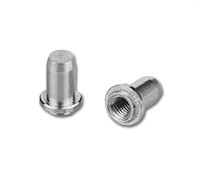
3.8 Millimeter (mm) Maximum Barrel Diameter D Carbon Steel Blind Press Nut
|
E11CF6880002
3.8 Millimeter (mm) Maximum Barrel Diameter D Stainless Steel Blind Press Nut
|
E11CF6880003
3.8 Millimeter (mm) Maximum Barrel Diameter D Carbon Steel Blind Press Nut
|
E11CF6880004
3.8 Millimeter (mm) Maximum Barrel Diameter D Stainless Steel Blind Press Nut
|
E11CF6880005
5.2 Millimeter (mm) Maximum Barrel Diameter D Carbon Steel Blind Press Nut
|
|
Description
|
N/A
Blind Press Nuts with sealed-thread are designed to provide extended thread lengths in thin sheet metal. Press nuts provide a seal against the entrance of dirt's, oils, moisture, and corrosive atmospheres. They are usually more economical to use than nut and screw-type hardware that require elaborate seals and special assembly procedures.
|
|
Thread Size
|
N/A
M3 x 0.5
|
N/A
M3 x 0.5
|
N/A
M3 x 0.5
|
N/A
M3 x 0.5
|
N/A
M4 x 0.7
|
|
Dimension C
|
N/A
6.35 mm
|
N/A
6.35 mm
|
N/A
6.35 mm
|
N/A
6.35 mm
|
N/A
7.95 mm
|
|
Minimum Panel Thickness
|
N/A
1 mm
|
N/A
1 mm
|
N/A
1.4 mm
|
N/A
1.4 mm
|
N/A
1 mm
|
|
Maximum Dimension B
|
N/A
0.097 mm
|
N/A
0.097 mm
|
N/A
1.37 mm
|
N/A
1.37 mm
|
N/A
0.097 mm
|
|
Maximum Barrel Diameter D
|
N/A
3.8 mm
|
N/A
3.8 mm
|
N/A
3.8 mm
|
N/A
3.8 mm
|
N/A
5.2 mm
|
|
Minimum Full Thread Depth X
|
N/A
5.3 mm
|
N/A
5.3 mm
|
N/A
5.3 mm
|
N/A
5.3 mm
|
N/A
7.1 mm
|
|
Maximum Dimension Y
|
N/A
8.5 mm
|
N/A
8.5 mm
|
N/A
8.5 mm
|
N/A
8.5 mm
|
N/A
9.8 mm
|
|
Maximum Shank Diameter A
|
N/A
4.22 mm
|
N/A
4.22 mm
|
N/A
4.22 mm
|
N/A
4.22 mm
|
N/A
5.38 mm
|
|
Dimension Z
|
N/A
9.6 mm
|
N/A
9.6 mm
|
N/A
9.6 mm
|
N/A
9.6 mm
|
N/A
11.2 mm
|
|
Minimum Center of Hole to Edge of Panel
|
N/A
4.8 mm
|
N/A
4.8 mm
|
N/A
4.8 mm
|
N/A
4.8 mm
|
N/A
6.9 mm
|
|
Material
|
N/A
Carbon Steel
|
N/A
Stainless Steel
|
N/A
Carbon Steel
|
N/A
Stainless Steel
|
N/A
Carbon Steel
|
|
Features and Benefits
|
N/A
Self-clinching fasteners are pressed into holes in sheet metal by applying a steady squeezing force. This results in the cold-flow of sheet material, which is displaced by the knurl, into the undercut area on the shank of the fastener. Once fully embedded, the knurled area prevents torque-out during tightening of mating part.
|